Prepped and Ready
What a Properly Ground Floor Looks Like
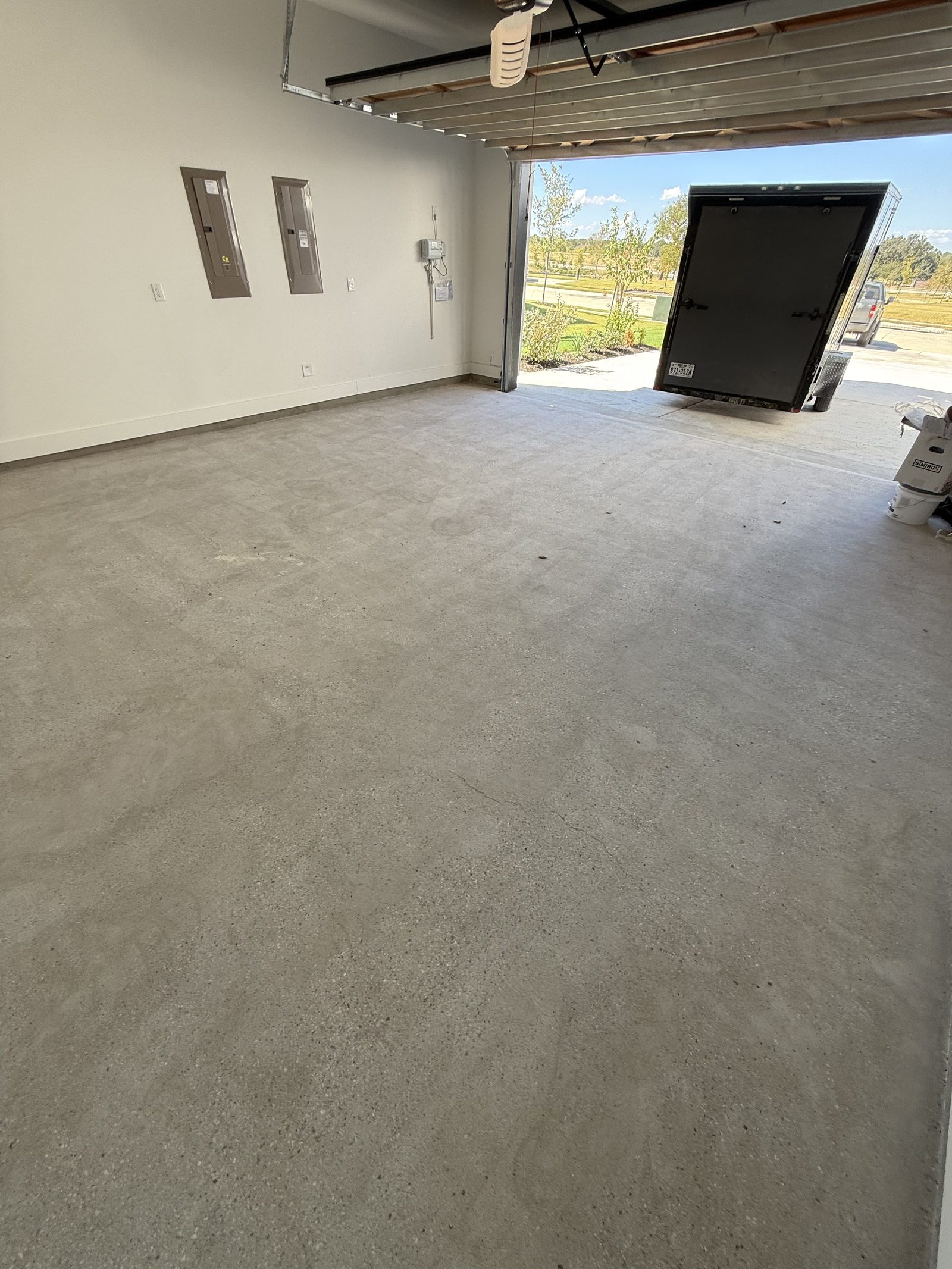
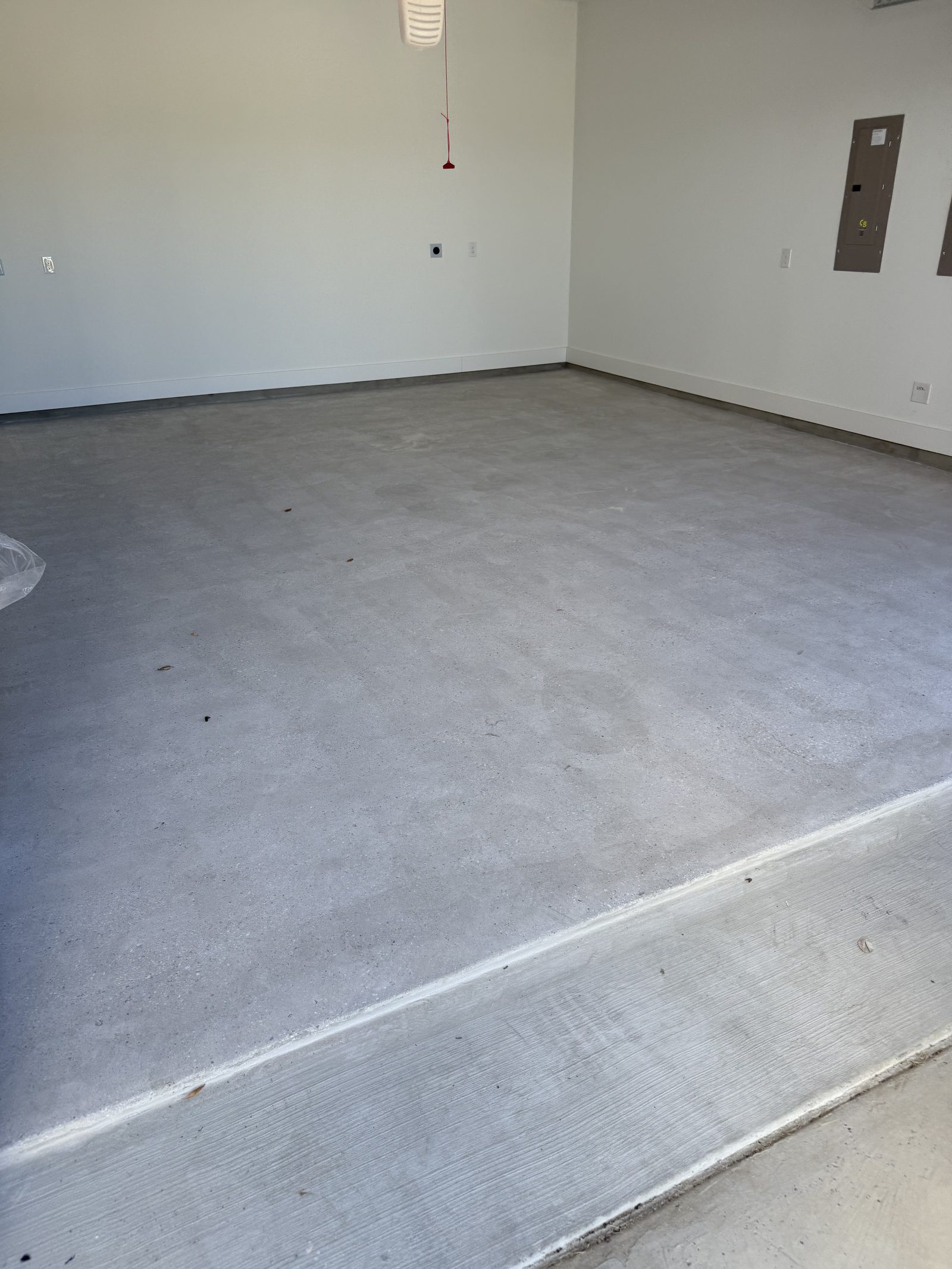
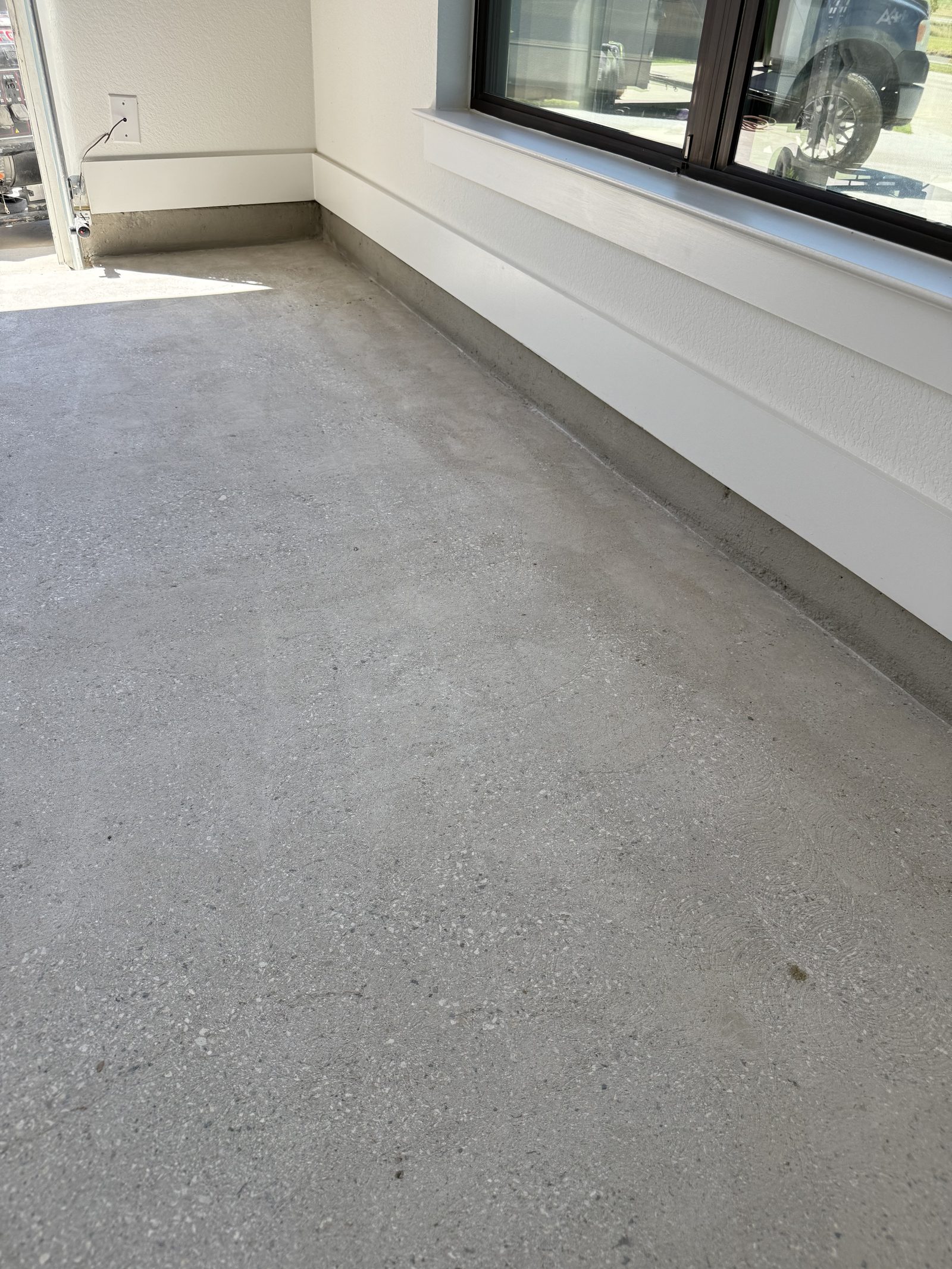
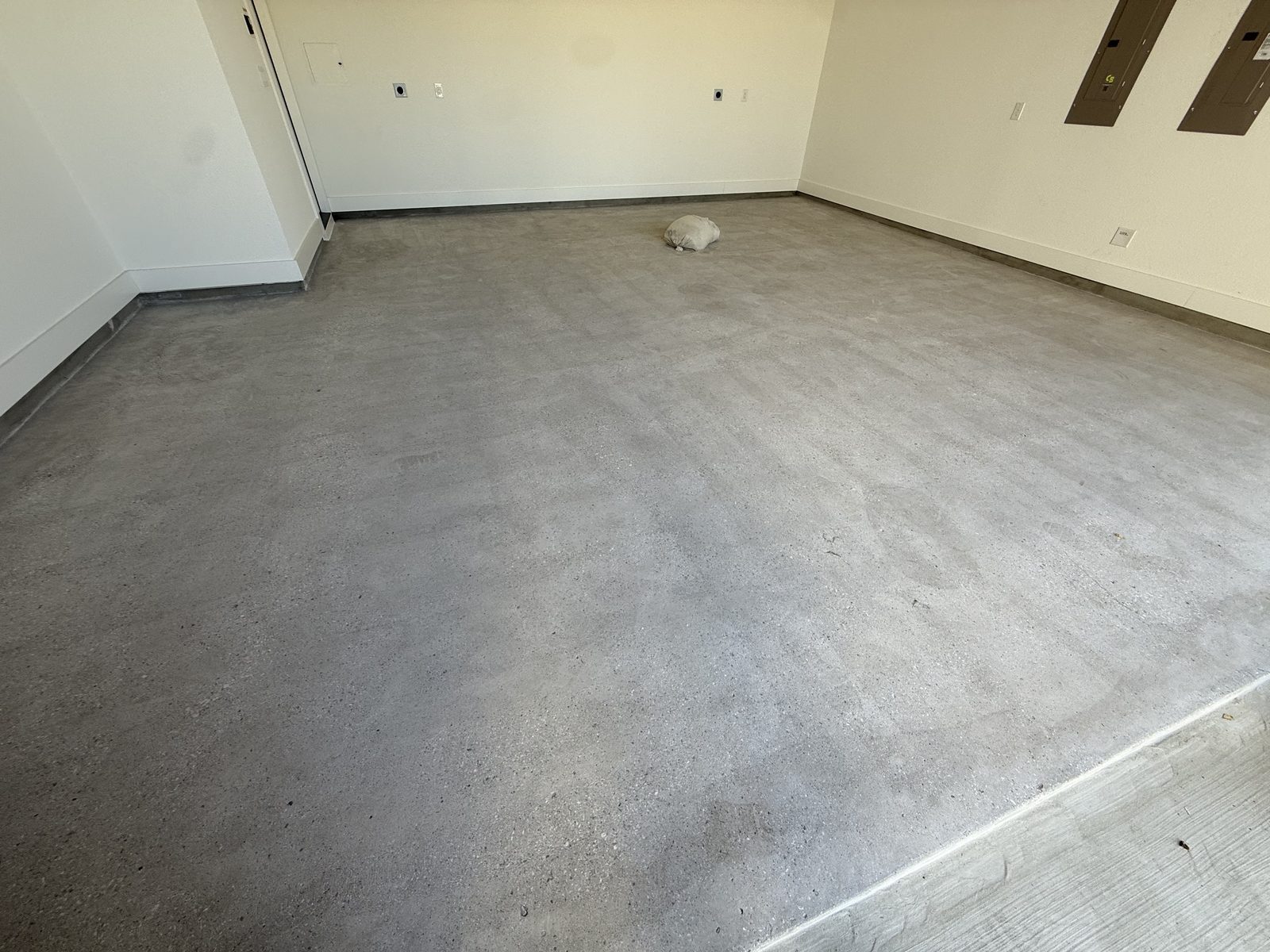
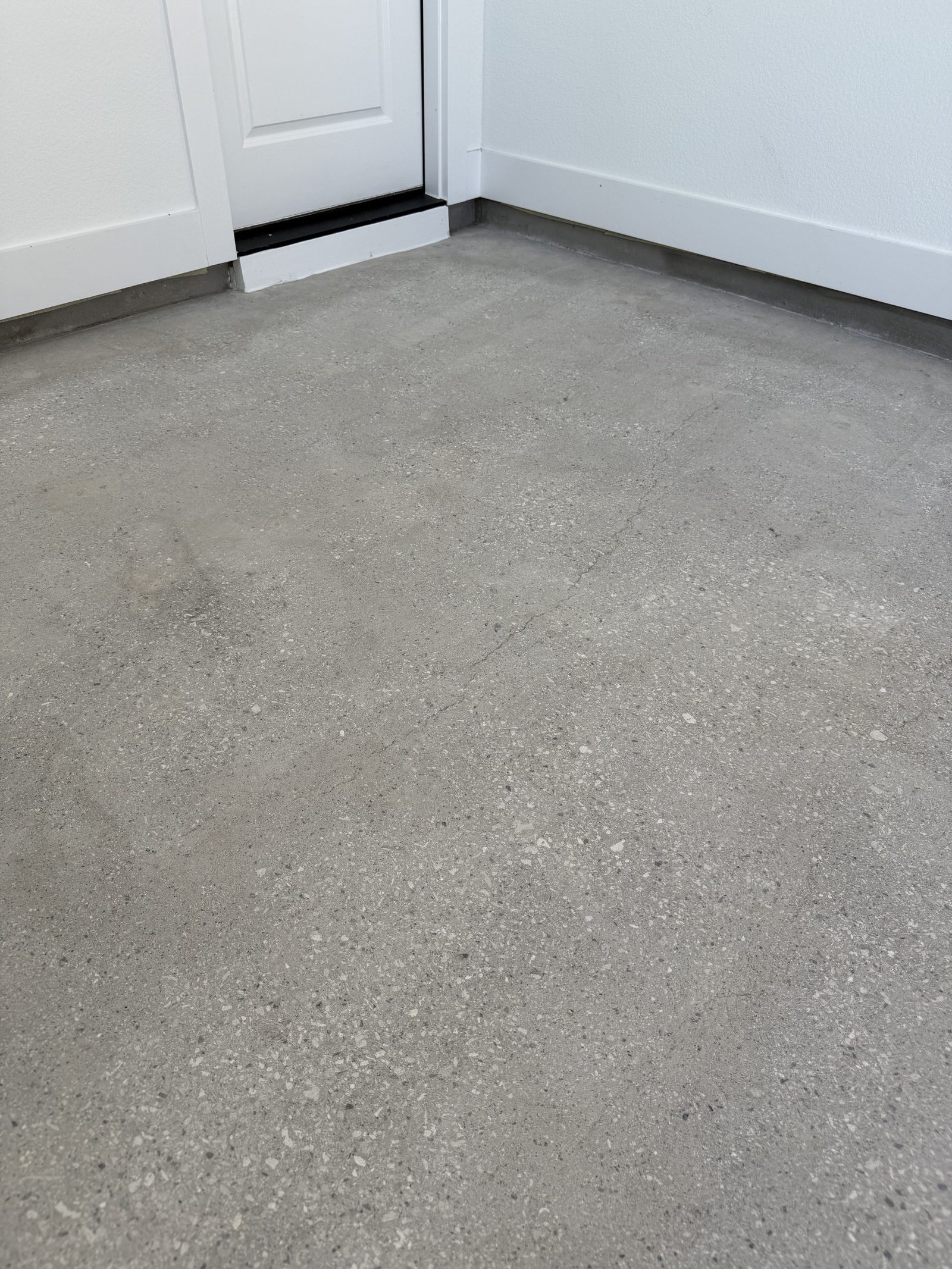
A coating is only as good as the concrete under it. Here is exactly how we grind, profile, and prepare your slab so the floor bonds for good and does not peel.
Almost every failed garage floor you have ever seen has the same root cause, and it is not a bad product. It is bad prep. When a coating lifts, peels, or bubbles a year after it went down, the concrete underneath was never truly ready to hold it. That is why we spend more time and care on the grinding than most crews spend on the entire job. Get the prep right and the floor lasts for decades. Get it wrong and nothing you put on top can save it.
Every floor we install starts the same way, on our hands and knees reading the concrete, then behind a diamond grinder opening it up. No acid wash shortcuts, no spray and pray, no exceptions.
We run heavy planetary grinders fitted with industrial diamond tooling across every square inch of your slab. The diamonds cut into the surface and remove the weak top layer of the concrete, the sealed and troweled skin that a coating cannot bite into. What is left behind is clean, open, textured concrete with thousands of tiny peaks and valleys. That texture is what a coating mechanically locks into, the same way a good tire grips a rough road instead of sliding across glass.
The goal is not just to scuff the surface. It is to reach a specific concrete surface profile, a measurable roughness, that matches the system going down on top. Too smooth and the coating has nothing to hold. Too aggressive and you waste product filling craters. Reading that line correctly is the craft.
Not all diamonds are the same, and using the wrong one is how a crew leaves a floor that looks ground but was never really profiled. The diamond segments on our grinders are held in a metal bond, and the hardness of that bond has to be matched to the hardness of your concrete. This is the part most contractors cannot even explain.
Here is the rule, and it runs backward from what most people expect. Hard, dense concrete calls for a softer bond. The soft metal wears away as it grinds, which keeps exposing fresh, sharp diamond to the slab. If you put a hard bond on hard concrete the diamonds polish over, glaze, and stop cutting. Softer concrete is the opposite. It needs a harder bond that wears slowly, or the tooling burns up in a fraction of the floor. Match the bond to the slab and the grinder cuts clean and true. Miss it and you either glaze the diamonds or grind your tooling to nothing.
We also step through grit. We open the concrete with a coarse metal bond diamond to make the real cut and set the profile, then refine as the system requires. When a floor already has an old coating, paint, glue, or mastic on it, we bring PCD tooling to strip it down to raw concrete first, then profile the fresh surface underneath. A failing old floor is not a problem for us, it is just step one.
Ask five contractors what diamond they use and most will give you a blank look. We carry three distinct types of tooling on the truck because no single diamond does every job well, and swapping mid-floor is normal, not a sign something went wrong.
Metal bond diamonds are the workhorses. The diamond grit is fused into a metal matrix, and that matrix is what we are matching to your concrete hardness. These are what open a slab, cut through laitance, and set the initial profile. They come in a range from very coarse, for stripping thick coatings or leveling an uneven pour, down to finer grits that start smoothing the scratch pattern the coarse step leaves behind.
Resin bond diamonds come in after the metal bond has done the cutting. The diamond grit here is held in a resin matrix instead of metal, which polishes rather than cuts. We do not use these for a coated floor since a coating needs an open, mechanical profile, not a polish, but they matter on exposed aggregate and polished concrete work where the final look is the concrete itself, ground and honed down through progressively finer grits until it shines.
PCD tooling, polycrystalline diamond, is our demolition tool. These segments are built to eat through thick mastic, old epoxy, urethane, glue, carpet adhesive, even paint that has been baked onto a slab for twenty years. A metal bond diamond will glaze over and quit if you point it at a half inch of old coating. PCD tears through it, and once the slab is bare we switch back to metal bond to set the real profile underneath.
The concrete industry has a standard for this, published by the International Concrete Repair Institute, running from CSP 1 up through CSP 9. CSP 1 is close to a steel-troweled, almost glassy surface. CSP 9 is a heavily fractured, aggressive profile you would see after scarifying or shot blasting for a thick overlay. Most residential and commercial coating systems, epoxy, polyaspartic, or polyurea flooring, want to land somewhere in the CSP 3 to CSP 5 range, a light to medium sandpaper-like texture you can feel with your hand but would never call rough.
Chasing that number is the whole point of matching diamond bonds and grit steps correctly. Too smooth, below CSP 3, and the coating has almost nothing to grab, it is basically sitting on top of the slab and waiting for an excuse to let go. Too aggressive, above CSP 6 or so for a standard coating, and you are pulling more material than the system needs, opening pinholes and bug holes that eat extra base coat to fill, and paying for grinding time that did not need to happen. We check the profile by feel and by eye on every floor, comparing it against the CSP standard the way a mechanic checks a torque spec instead of just guessing at tight.
People ask why we do not just shot blast, or why we will not touch an acid etch job. Here is the honest comparison.
Shot blasting fires small steel shot at the slab at high velocity to fracture the surface, then vacuums the shot back up for reuse. It is a legitimate industrial method, common on large commercial floors and warehouses where speed on a huge square footage matters more than a fine finish. On a residential garage or a barndominium shop, it is overkill, harder to control in tight corners and along walls, and the equipment is not something a small crew runs efficiently on a 500 to 1,500 square foot floor. Diamond grinding gives us tighter control at the edges and a more consistent profile on the floor sizes we work most often.
Acid etching is the method every big box store epoxy kit tells you to use, and it is the reason so many DIY garage floors peel within a year or two. Muriatic acid diluted with water is mopped onto the slab to lightly dissolve the surface. The problem is consistency. Acid reacts differently depending on the concrete's age, density, and sealers already on it, so you get an uneven bite, you cannot open a truly dense or previously sealed slab with it at all, and the reaction leaves a residue that has to be neutralized and rinsed perfectly or it fights the coating from underneath. We do not use acid etching on any job. It is not a prep method we trust under work that has to hold up for years.
Diamond grinding is mechanical, not chemical. It works the same way on a 3-year-old slab or a 30-year-old slab, on soft concrete or hard concrete, sealed or unsealed, coated or bare, because we are physically cutting the surface open rather than hoping a reaction takes. It is dust, not runoff, so there is nothing to neutralize, nothing that can wash into a driveway or a yard, and no guessing about whether the chemistry worked. That control is worth the extra time it takes.
Before a single diamond touches your floor we test it. We check how hard and dense the slab is, because that decides the bond we reach for. We look for moisture, since a slab that pushes vapor from the ground up needs a moisture barrier or the best coating in the world will still let go. We check for old coatings and how they were installed. Two garages built the same year can grind completely differently, and the crew that assumes instead of testing is the crew whose floors come back.
Moisture is the one that costs people the most, because you cannot see it and you cannot always feel it, but it is sitting under a huge share of failed floors across Texas. Concrete slabs poured directly on grade, which is most garages, barns, and shop floors out here, sit on soil that holds moisture, and that moisture wants to move upward through the slab as vapor. Clay-heavy soil, which covers a lot of North and Central Texas, holds and releases water more aggressively through wet and dry seasons than sandier ground does, so a slab that tested fine in August can be pushing real vapor by the following spring.
We test for it two ways depending on the job. A calcium chloride test tapes a small dome to the concrete for 60 to 72 hours and measures how much moisture the slab gives off in that window, reported in pounds per 1,000 square feet per 24 hours. A relative humidity probe, drilled into the slab and sealed for several days, reads the moisture condition deeper in the concrete and tends to be the more reliable number on a thicker or older pour. Either way, if the reading comes back high, we do not just cross our fingers and coat over it. We install a moisture vapor barrier as part of the base coat system, a product built specifically to block that vapor from reaching the epoxy or polyaspartic above it. Skip that step on a high-moisture slab and you get bubbling, blistering, or a coating that delaminates in sheets, sometimes within months.
Most homeowners have never watched a floor get properly prepped, so here is what a grind day looks like start to finish on a typical garage or barndominium floor.
We start by walking the slab and running our moisture and hardness checks, then clear and mask anything that needs protecting, baseboards, cabinets, water heaters, and the like. The grinders go on next, planetary heads with the bond we matched to your concrete, run in overlapping passes across the entire floor. A dust shroud rides on the machine the whole time, pulling the concrete dust straight into a HEPA vacuum so it never gets the chance to spread through the garage or into the house.
We work the edges and corners by hand with smaller grinders, since the big planetary heads cannot reach tight against a wall or into a corner, and that hand work is exactly where a rushed crew cuts a corner, leaving a ring of unprofiled concrete around the perimeter that shows up as a picture frame of peeling coating a year later. We do not skip it.
Once the grind is done we vacuum the entire floor again, check the profile against what the coating system calls for, patch any cracks, pits, or expansion joints that need it, and vacuum one more time before the base coat ever goes down. On a standard garage, prep alone typically runs a half day to a full day depending on square footage, the condition of the existing surface, and whether we are stripping an old coating first. It is not the fast part of the job. It is the part that decides whether the fast part, laying down flake and topcoat, actually holds.
If you are getting bids and want to know whether a contractor is actually going to grind your floor or just wants to spray a coating over what is there, here is what to ask and what to watch for.
A quote that does not mention grinding, profiling, or surface prep at all, and jumps straight to talking about color and flake, is a quote from a crew planning to skip it or gloss over it. Ask directly whether they diamond grind or acid etch, and ask what CSP or profile they target. A contractor who cannot answer in plain language has probably never had to think about it.
If you already have a coated floor that is failing, look at how it is failing. Peeling in large sheets, especially starting at the edges or in high-traffic tire paths, points straight to poor adhesion from inadequate prep. Bubbling or blistering, especially in patches rather than one clear impact spot, points to moisture pushing up from underneath with no vapor barrier in place. A floor that never truly bonded will often let go with a hollow, almost papery sound when you tap it, versus a floor with a real mechanical bond that stays locked to the slab even as the topcoat eventually wears.
Diamond grinding sounds like it should leave your garage buried in concrete dust, and with the wrong equipment it will. That is not how we run it. Every grinder we use is fitted with a sealed dust shroud, a housing that surrounds the diamond head and creates a vacuum path instead of an open cloud. That shroud connects straight to an industrial HEPA vacuum, rated to capture fine respirable concrete dust, the kind of silica dust that is a real long-term health concern for anyone breathing it without capture in place.
The result is a job site that stays walkable. We are not saying it is spotless with zero dust anywhere, grinding concrete is still grinding concrete, but you will not walk into your garage that evening to a gray film over every surface, your tools, your workbench, your parked cars. Anything that does settle wipes away easily. Compare that to an acid etch job, which trades airborne dust for a chemical runoff that has to be neutralized and rinsed, sometimes more than once, and often leaves a faint white haze behind if it is not done exactly right.
Diamond grinding mechanically opens the concrete and gives an even, measurable profile that a coating can lock into. Acid etching is inconsistent, leaves residue behind, and cannot cut a dense slab. Grinding is the only prep we trust under a floor that has to last.
We match the diamond bond to the hardness of your slab. Hard, dense concrete gets a softer bond so the metal wears and keeps exposing fresh diamond. Softer concrete gets a harder bond so the tooling does not burn up too fast. The wrong bond leaves a floor that looks ground but is not truly profiled.
Very little. We run dust shrouds and HEPA vacuums right on the grinders, so the concrete dust is captured at the tool. Your garage stays clean and you are not left with a gray film over everything.
Yes. We use PCD tooling and coarse metal bond diamonds to strip old epoxy, paint, glue, and mastic down to raw concrete, then profile it fresh. A failing old floor is just step one.
CSP is the industry scale, 1 through 9, for how rough a ground concrete surface is. Most coating systems need a CSP 3 to 5, a light sandpaper texture. Too smooth and the coating cannot grip. Too rough and you waste product filling holes. We check every floor against that standard instead of guessing.
Shot blasting works well on huge commercial floors, but it is hard to control tight against walls and corners on a standard garage or shop. Diamond grinding gives us tighter, more consistent control on the residential and barndominium floor sizes we work most, which is why we reach for it instead.
We run a calcium chloride test or a relative humidity probe before we ever coat a floor. If the reading comes back high, which is common on clay soil across North and Central Texas, we install a moisture vapor barrier as part of the base coat so trapped vapor cannot bubble or delaminate your finished floor.
A standard garage typically takes a half day to a full day for prep alone, depending on square footage and whether we are stripping an old coating first. Prep is the slowest part of the job on purpose. It is what decides whether the rest of the install actually holds.
Every floor we install starts with a proper diamond grind. Call for a free estimate and we will read your concrete and tell you exactly what it needs.