Recent Work
A Shale Patio, Start to Finish
Diamond ground, professionally coated, built to last. The Epoxy Company serves Sherman, Grayson County, and the neighborhoods growing up around it with the same system that's earned us a 5.0★ rating across 120+ reviews from real Texas homeowners.
Sherman sits right next door to our home base in Denison, so it's some of the most familiar ground we cover. We know the concrete throughout Grayson County, the clay-heavy soil, the moisture challenges, the temperature swings, and we don't skip the moisture vapor barrier on anything above The Base tier because of what that soil does to a slab over time.
Whether you're in an older neighborhood with a slab that's seen 30 Texas summers or a newer build that just needs a showroom finish, we know exactly what your concrete needs.
Grayson County keeps growing, and Sherman has changed a lot in the last few years right along with it. The Texas Instruments plant going in north of town has pulled in new construction, new subdivisions, and a wave of homeowners who want their garage to match a brand-new house. At the same time, Sherman still has plenty of older streets near Austin College and downtown with concrete that has seen decades of Texas heat and never been touched. We treat those two situations completely differently, because a thirty-year-old slab and a slab poured last year don't need the same prep, even if they're three streets apart.
Every install in Sherman starts with diamond grinding and ends with a polyaspartic topcoat. The difference is in the layers.
Every contractor promises a great floor. Here's what we actually do differently.
"Best garage floor I’ve ever seen. The Epoxy Company showed up on time, kept everything clean, and the final product is absolutely incredible. My neighbors can’t stop asking who did it."
"I got three quotes. They were the only company that explained exactly what prep work they do. I went with The Pro package and two years later it still looks brand new."
"They drove out to our place, no complaints, no extra fees. Done our 3-car garage in two days. Looks like something out of a magazine. Highly recommend."
The Epoxy Company installs epoxy and polyaspartic floors throughout Sherman and the surrounding Grayson County & Far North area. Not seeing your town? We cover all of North, East & Central Texas, just ask.
Being eleven miles from our own shop in Denison means Sherman jobs run the same as home-turf jobs for us, same-day scheduling flexibility, no travel surcharge, and a crew that already knows the neighborhoods. We coat garages off Travis Street and around Austin College just as often as the new builds going up in the subdivisions pushing out toward the Texas Instruments plant, and the two require a different read of the concrete before we ever mix a batch.
Older Sherman slabs, especially anything poured before the 2000s, tend to have been sealed or painted at some point with a product that has to come off before a real coating system will bond. We check for that on every estimate, since coating over an old, failing sealer just guarantees a second failure a year later. Newer Sherman construction is the opposite problem: young concrete that's still curing and off-gassing moisture, which is exactly why we test before we coat rather than assuming a brand-new slab is automatically dry.
Every Sherman install still starts with a diamond grind, no acid wash shortcuts, because that mechanical profile is what lets the base coat lock into the concrete instead of sitting on top of it waiting to peel. From there it's the same three systems we run everywhere in Grayson County: The Base for a solid flake floor, The Pro with the moisture vapor barrier for most homeowners, and The Flagship with a double polyaspartic topcoat for anyone who wants the deepest gloss we make.
Sherman's growth also means more shop and warehouse-style concrete coming our way, bays that see forklifts, pallet jacks, and daily foot traffic instead of just a truck parked overnight. We build those floors the same way we build a barndominium floor: heavier topcoat, careful attention to the moisture reading, and a grind sequence matched to how dense and how old that particular slab actually is.
If you're weighing quotes in Sherman, ask any contractor whether they diamond grind or acid etch, and ask what they test for before they coat. Those two answers tell you more about how long your floor will last than anything in a glossy brochure. Call or text 817-818-6925 for a free Sherman estimate, we'll come look at your actual concrete and tell you straight what it needs.
Most Sherman homeowners land on The Pro, and there's a straightforward reason why. Grayson County clay pushes moisture up through a slab more than sandier soils do, and The Pro is the first tier that includes the moisture vapor barrier primer that actually blocks that. The Base is still a real, durable flake floor, diamond ground and finished with a polyaspartic topcoat, and it's the right call on a newer slab that tests dry or on a budget where the difference matters more than the extra protection.
The Flagship earns its price on floors people spend real time in, oversized garages set up as a second living space, shops where the finish matters as much as the durability, or anyone who wants the deepest, glossiest look we offer. Two coats of polyaspartic instead of one means more film build, more UV protection, and a look that reads as noticeably richer than a single-topcoat floor. We'll tell you honestly which tier fits your slab and your goals rather than steering everyone toward the most expensive option.
Day one is prep and base coat. We grind the concrete down to a clean, profiled surface, vacuum it thoroughly, and address any cracks or old coating residue before anything goes down. The base coat goes on next, and while it's still tacky we broadcast flake to full rejection, meaning we keep throwing until the surface can't hold any more. That's what gives a Sherman floor the dense, professional look instead of a thin, sprinkled appearance.
Day two is topcoat day. Once the flake has cured, we scrape it back smooth and roll the polyaspartic topcoat over the full floor. Polyaspartic cures fast, which is part of why we favor it, most Sherman customers can walk on the floor within about a day and drive on it within a few days, without the week-long wait some epoxy-only systems require. We'll give you the exact timeline for your specific floor before we start.
A properly installed system in Sherman needs very little upkeep. Regular dust mopping or sweeping handles everyday dirt since nothing grinds into a sealed polyaspartic surface the way it does on bare concrete. For anything more stubborn, warm water and a mild soap with a soft brush is usually enough, and the floor can be power washed once fully cured. The one thing worth staying on top of is wiping up oil, coolant, or fertilizer promptly rather than letting it sit for days, since resistant to chemicals isn't the same as immune to them over a long soak.
Beyond that, there's nothing to maintain. No annual resealing, no waxing, no specialty cleaning products. That's the whole point of building the system right the first time, prep, materials, and application all done properly so the floor takes care of itself for years.
We run Simiron base coats and Torginol flake on nearly every Sherman job, not because of a supplier deal, but because we've tested the cheaper alternatives over the years and watched them underperform on North Texas concrete. Simiron's slow-cure formulas give the material time to fully wet into a freshly diamond-ground profile before it starts to set, which matters on a hot Sherman afternoon in a way it wouldn't in a climate-controlled shop somewhere else. Torginol flake holds its color instead of fading out after a couple of summers behind a west-facing garage door.
The topcoat matters just as much as what's underneath it. We run polyaspartic rather than a straight epoxy topcoat because polyaspartic stays UV stable, meaning it won't yellow or chalk the way plenty of epoxy-only systems do after enough sun exposure. It costs more to build a floor this way than to run the cheapest system available, but it's the reason Sherman floors we installed years back still look freshly done.
Sherman has its share of national garage-flooring franchises advertising heavily right now, and it's worth knowing what you're actually comparing when you get quotes. A franchise operation often subcontracts the physical installation to whoever is available that week, meaning the crew that shows up isn't necessarily the same people, or the same standard, every time. With us, the person who walks your garage and gives you the estimate is the same person running the grinder and rolling the topcoat. There's no layer between the quote and the work.
Franchise pricing also tends to be built around a national ad budget, which shows up in the bill whether or not it shows up in the floor. We keep our overhead low and our crew small on purpose, so the money goes into materials and labor instead of marketing spend. If you want to compare us fairly against a franchise quote, ask both companies the same three questions: do they diamond grind or acid etch, do they test for moisture before they coat, and who exactly will be doing the physical work. The answers tend to make the decision easy.
A lot of what we're called out for around Sherman isn't inside the city grid at all. Grayson County has plenty of acreage properties, barndominiums, and rural shops within a short drive of town, and those jobs get the same standard as anything inside Sherman proper, just with a bigger bay and often a denser slab poured to carry equipment and trailers. Being local means that drive is never a reason to push your job to the back of the schedule or quote you differently than a homeowner two streets from downtown.
Whatever your property looks like, garage, shop, or barndominium, the estimate is free and the process is the same: we come look at your actual concrete, test it if there's any question about moisture, and tell you plainly which of our three systems fits what you're trying to get out of the floor. Call or text 817-818-6925 whenever you're ready.
The estimate itself usually takes fifteen to twenty minutes. We walk the space, check the slab for cracks, existing coatings, and any moisture concerns, measure the square footage, and talk through which of the three systems makes sense given how you actually use the space. If you park two daily drivers and never think about the garage otherwise, that's a different recommendation than if you're setting up a home gym, a workshop, or a spot to work on cars on weekends.
We'll give you a firm price before we leave, not a vague range you have to chase down later, and we schedule the actual install around your calendar rather than making you wait weeks for an opening. There's no pressure to decide on the spot. Compare us against whoever else you're getting a quote from, and when you're ready, we'll get you on the books.
Bring your questions to that walkthrough. Ask what happens if a crack shows up under the old sealer once we grind it off, ask how the price changes if the garage turns out to be bigger than expected, ask what the warranty actually covers. A contractor who answers those plainly, on the spot, standing on your concrete, is telling you a lot more than a polished sales pitch ever will.
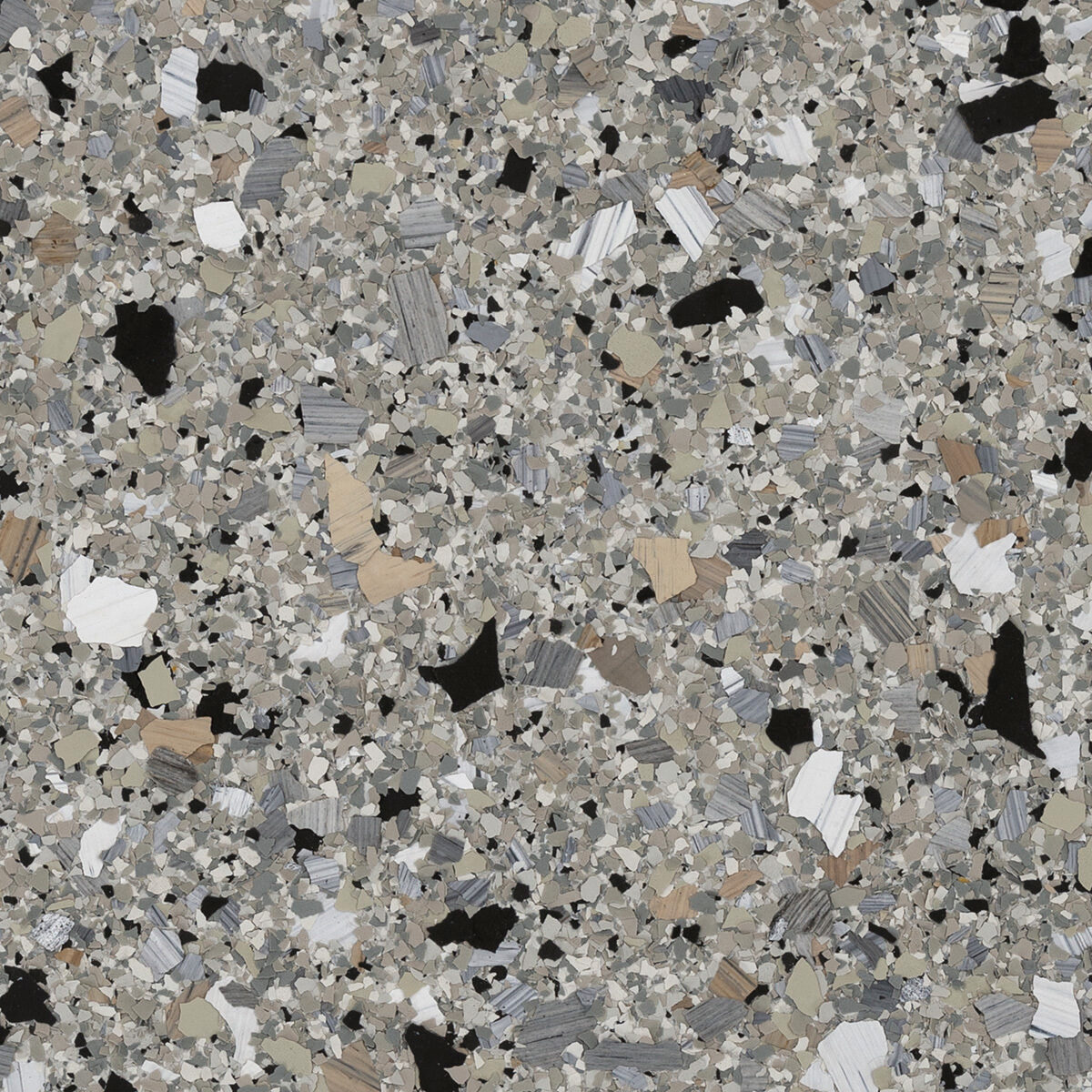
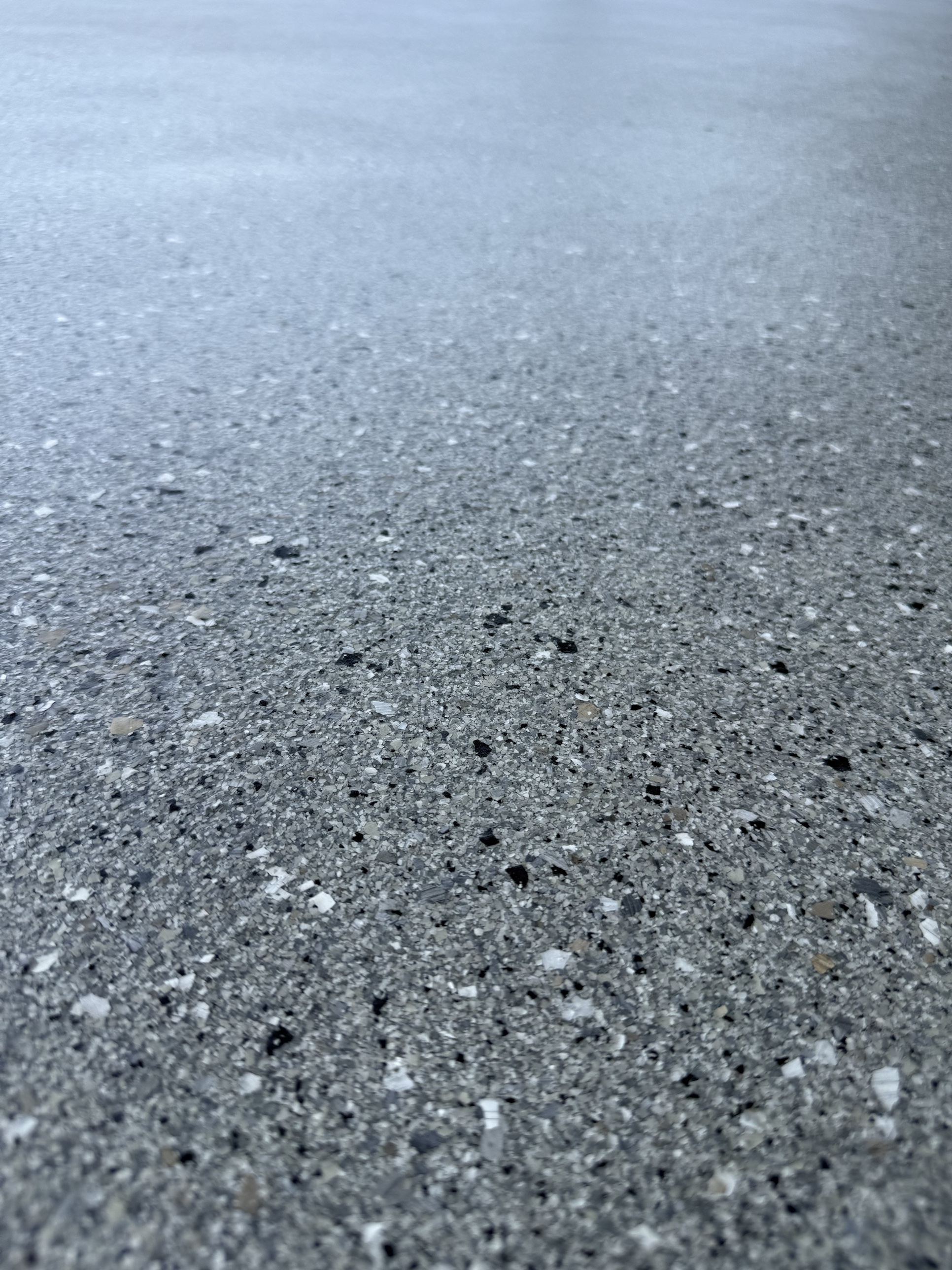
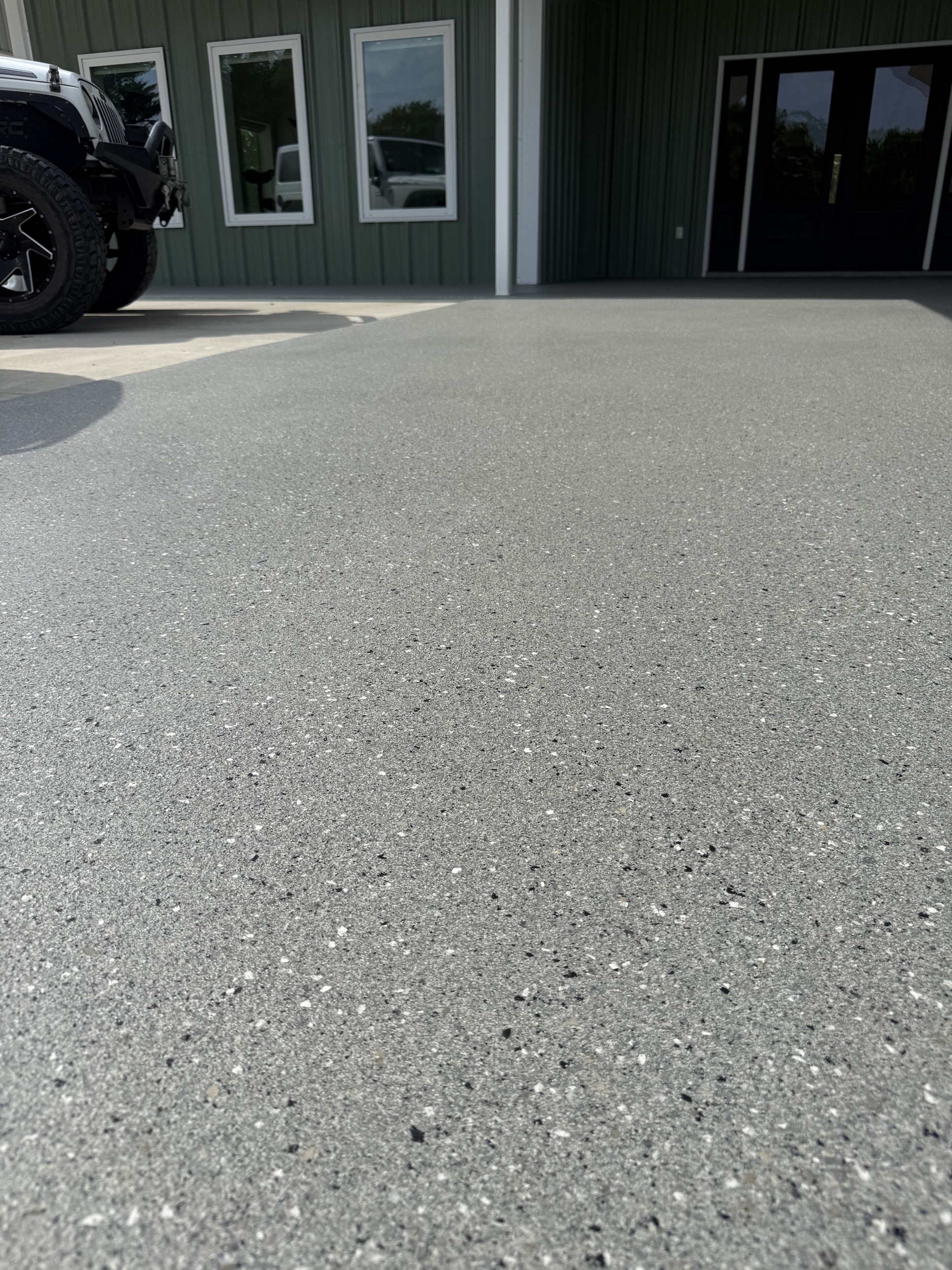
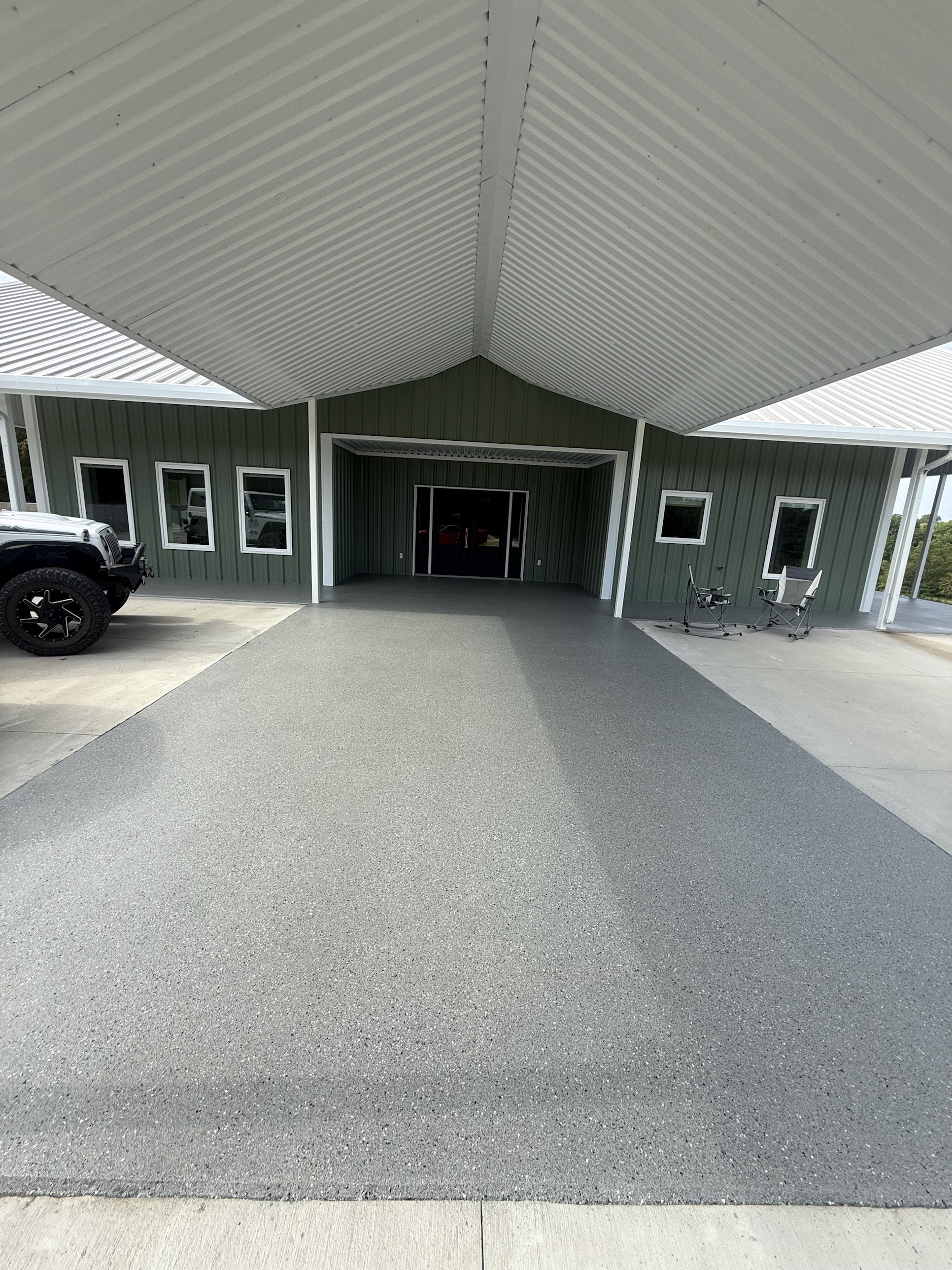
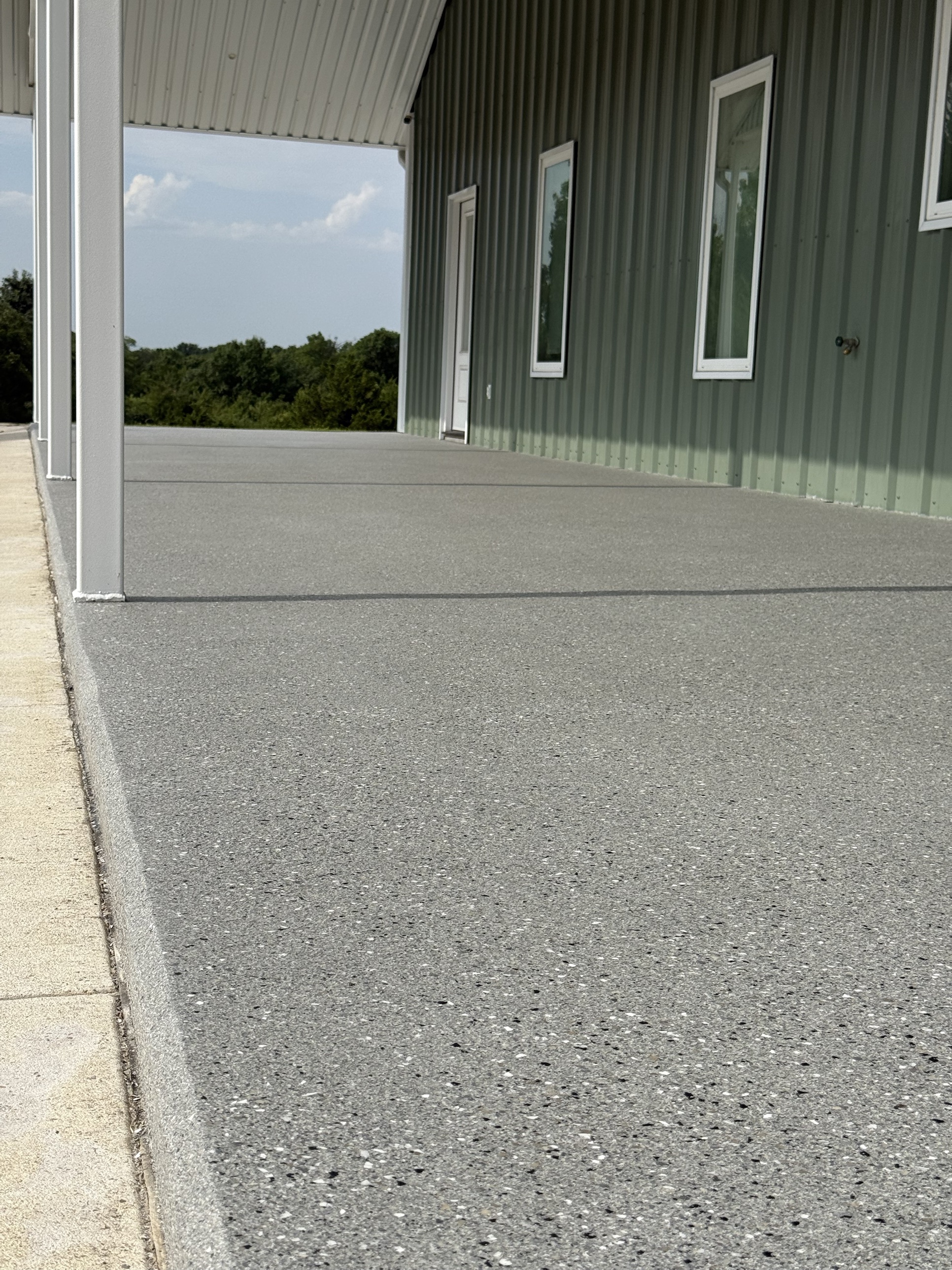
This covered patio in Sherman came out in Shale, one of our most requested colors for outdoor spaces because it reads as a natural stone gray in full sun without going stark white or too dark to stay cool underfoot. The homeowner has a metal building with a wide covered breezeway running the length of it, and wanted the whole slab to match front to back instead of just a small pad by the door.
We started the way we start every job, diamond grinding the concrete to mechanically open the surface so the coating has something real to bite into. From there we laid down a moisture vapor barrier epoxy at 100 square feet per gallon. There was no active moisture problem showing on this slab, but we run the barrier anyway as insurance. If moisture ever does try to work its way up through the concrete down the road, that layer is already there to stop it before it reaches the coating above.
There is a second reason we always start with an epoxy base rather than going straight to polyaspartic: polyaspartic does not bond well directly to bare concrete. Starting with the moisture vapor barrier epoxy solves both problems in one step, it gives the polyaspartic something to grip, and it protects the slab. From there we broadcast the flake into that first layer of polyaspartic and followed it with two more full coats of polyaspartic on top.
We run polyaspartic as the topcoat instead of straight epoxy because it is UV stable. An outdoor patio like this one sits in full Texas sun for most of the day, and a straight epoxy topcoat will yellow and chalk out in a year or two under that kind of exposure. Polyaspartic holds its clarity and its color for years. Starting with epoxy for the bond and the moisture protection, then finishing in polyaspartic for the UV resistance, gives you the best of both instead of picking one weakness over another.
Materials on this job were Simiron for both the epoxy and the polyaspartic, and we ran extra-slow-cure across the board. Slow cure costs us time on site, but it gives the chemicals room to fully sit and work before they set up, and that patience shows in the final finish. For the topcoat we sprayed in Coval, a matting additive, to knock the gloss down and cut the glare. On a covered patio that catches direct sun most of the day, a high-gloss finish throws that light right back up at anyone sitting out there. We recommend a matte finish on any patio or outdoor living space that gets that kind of sun exposure. It keeps the space comfortable to actually use instead of squinting through a mirror all afternoon.
Most Sherman garage floors run about $6 to $10 per square foot installed. The Base system starts at $6, The Pro at $8, and The Flagship at $10. Your exact price depends on the size and condition of your concrete, and every estimate is free.
Most residential floors in Sherman are finished in one to two days. We diamond grind the concrete, lay the base coat and flake, then return for the polyaspartic topcoat. You can usually walk on it the next day and park on it within a few days.
Yes. A properly prepped floor resists hot tires, oil, and chemicals, cleans up with a mop, and lasts for years without peeling. In the Sherman heat and clay soil, the prep and moisture barrier we use are what keep it down for the long haul.
Dry, our flake floors have real texture and the polyaspartic topcoat is rated for traction. Any hard floor gets slick when wet, so for extra grip we can add an aluminum oxide anti-slip additive to the topcoat for a little more.
Yes. The Epoxy Company is based in Denison and covers Sherman and the surrounding area. Garages, shops, and barndominiums are what we do best, and estimates are always free. Call 817-818-6925.
We let the work speak. We diamond grind every floor, use quality Simiron and Torginol materials, coat clean out to the door, and back it with a workmanship warranty. Call 817-818-6925 for a free Sherman estimate.
Yes, but it has to come off first. Coating over an old, failing sealer just gives you a second failure a year later. We remove old coatings as part of the diamond grinding process so the new system bonds directly to clean concrete.
Yes. With Sherman's growth we're coating more shop, warehouse, and commercial bay floors that see forklifts and daily foot traffic. We run a heavier topcoat and adjust the grind sequence to the density of that concrete rather than treating it like a standard two-car garage.
Almost never. Diamond grinding removes old sealers, minor surface damage, and stains that would ruin a cheaper prep method. Significant structural cracking or heaving needs to be addressed first, but we can tell you that honestly during a free estimate before any work starts.
Free estimate for Sherman homeowners. We come to you, assess the concrete, and give you an honest recommendation with no pressure.